5 of the 11 bookshelf speakers whose manufacturer publishes a US list price fall in this band. Every figure below is the manufacturer’s own, linked to the page it came from.
Last verified: 2026-08-09
What “mid-range” means here
A price band has to be drawn somewhere, so we draw it on manufacturer list price and say where. This page is $500 up to $1,000. List price is not street price. These models discount, some of them heavily, and a model at the top of one band is often bought for less than one at the bottom of the next. We do not publish retailer prices, because a price we cannot keep current is worse than no price at all. Use the band to narrow the field, then check what it actually costs today.
We hold 16 bookshelf speakers in the database. 11 of them have a list price published by the manufacturer; the other 5 do not, and are named at the foot of this page rather than guessed into a band.
The 5 in this band

Triangle Borea BR03
- Published sensitivity
- 90 dB, 1 W at 1 m
- Nominal impedance
- 8 ohms
- Minimum impedance
- 4.2 ohms
- Frequency response
- 46 Hz – 22 kHz ±3dB
- Type
- passive — needs an amplifier
What the published figures favour
- Above the median of this set on a common basis: 90.0 dB against a median of 86.5 dB, so it reaches a given level on less amplifier power.
- Minimum impedance stays at 4.2 ohms, so it is an easier load than most of this set.
- Frequency response published as 46 Hz – 22 kHz at ±3dB. Quoting the tolerance is the exception here, not the rule.
- Manufacturer states a recommended amplifier power of 80–500 W, which many of its competitors leave out.
- Cabinet dimensions published: 380 × 206 × 314 mm, so you can check it fits before ordering.
What to check before buying
- Nothing in the published data raises a flag.
What reviewers report 5 published reviews read
Reviews of the Borea BR03 are warm about the sound and unusually specific about the practical problems, which makes them more useful than most. The recurring theme is that this speaker rewards being given room, and punishes being shoved on a shelf — a point that matters more than usual because at 380 mm it is the tallest cabinet on this page.
Consistently praised
- Scale and separation are the consistent praise. Reviewers repeatedly report a soundstage larger than the cabinet implies, with instruments placed distinctly rather than smeared together. Multiple sources describe this as the speaker’s defining quality at the price.
- The midrange is described as natural and organic, and the treble as sweet rather than aggressive, by several independent reviewers. The overall character is repeatedly called laid-back, which reviewers contrast explicitly with more forward designs at similar money.
- It is the only speaker on this page whose manufacturer publishes sensitivity already at 1 W and 1 m, so its 90 dB figure needs no correction — and reviewers’ reports that it drives easily are consistent with that.
Consistently criticised
- Placement is the dominant practical warning and it comes up in nearly every review. Although the port fires forward, which usually means a speaker tolerates being near a wall, Triangle asks for roughly 40 cm of clearance behind it and reviewers confirm the speaker needs that space to perform. On a bookshelf pushed against a wall, reviewers report it does not deliver what they heard on stands.
- The 380 mm height is flagged repeatedly as awkward. It is taller than every other cabinet here and will not fit many standard shelves.
- A slight peakiness in the treble is noted by more than one reviewer, and the styling is repeatedly described as divisive. Reviewers also caution it may not have the output for genuinely large rooms without a capable amplifier.
Reviewers point to it suiting
Stand-mounted use in a small or medium room, with space behind the speakers, for a listener who prefers a relaxed presentation.
Reviewers suggest looking elsewhere if
It has to sit on a shelf against a wall, your shelf is under 400 mm tall, or you need to fill a large room.
Sources: What Hi-Fi · 7Review · iiWi reviews. These are other reviewers’ findings, not ours — we have not heard this speaker.
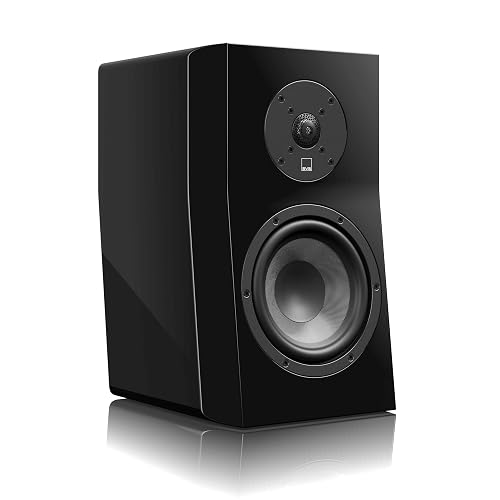
SVS Ultra Evolution Bookshelf
- Published sensitivity
- 87 dB, 2.83 V at 1 m, full space
- Nominal impedance
- 6 ohms
- Minimum impedance
- not published
- Frequency response
- 40 Hz – 40 kHz ±3dB
- Type
- passive — needs an amplifier
What the published figures favour
- Frequency response published as 40 Hz – 40 kHz at ±3dB. Quoting the tolerance is the exception here, not the rule.
- Manufacturer states a recommended amplifier power of 20–150 W, which many of its competitors leave out.
What to check before buying
- Below the median of this set once corrected: 85.7 dB against a median of 86.5 dB, so it needs more power for the same level.
- Published at 2.83 V into 6 ohms, which is more than one watt. Corrected to 1 W the figure falls to 85.7 dB.
product listing
Wharfedale Diamond 12.2
- Published sensitivity
- 86.5 dB, 2.83 V at 1 m, full space
- Nominal impedance
- 8 ohms
- Minimum impedance
- 3.7 ohms
- Frequency response
- 50 Hz – 20 kHz ±3dB
- Type
- passive — needs an amplifier
What the published figures favour
- Above the median of this set on a common basis: 86.5 dB against a median of 86.5 dB, so it reaches a given level on less amplifier power.
- Frequency response published as 50 Hz – 20 kHz at ±3dB. Quoting the tolerance is the exception here, not the rule.
- Manufacturer states a recommended amplifier power of 20–120 W, which many of its competitors leave out.
- Cabinet dimensions published: 330 × 200 × 312 mm, so you can check it fits before ordering.
What to check before buying
- Impedance drops to 3.7 ohms. Check your amplifier publishes a 4-ohm rating before driving it hard — most AV receivers do not.
What reviewers report 5 published reviews read
The Diamond 12.2 produces the clearest disagreement between sources of anything on this page, and we are not going to resolve it for you. Reviewers agree the bass is strong for the money and the build is beyond the price. They do not agree about the top end, and one measured review raises a specific concern in the vocal band that the subjective reviews do not mention. Both positions are recorded below.
Consistently praised
- Bass weight and extension are the most repeated praise. One measured review found the real response bettered Wharfedale’s own 50 Hz claim, and reviewers describe the speaker as weighty and hard-hitting rather than merely adequate — unusual at this price and in this cabinet size.
- Reviewers consistently describe it as engaging and propulsive on faster material, with several framing the speaker as fun rather than analytical.
- Build quality, finish and styling are called out by multiple sources as beyond what the price would suggest.
Consistently criticised
- The top end splits opinion. Some reviewers describe the mids and highs as sharp or harsh; others do not raise it at all. This is the clearest source disagreement on this page and we record it as unresolved rather than picking a side.
- One measured review reports distortion peaks of roughly 1.8% around 190 Hz and about 3% around 560 Hz. The second figure is the one worth knowing: 560 Hz sits in the vocal range, where the ear is least forgiving. No subjective review we read raises it, which is itself worth noting — measurement and listening are disagreeing here.
- The same review describes the bass as occasionally loose, which sits directly against the praise for bass weight elsewhere. Reviewers appear to be trading extension against control.
Reviewers point to it suiting
Someone who wants bass weight and cabinet quality for the money, and listens more for engagement than for neutrality.
Reviewers suggest looking elsewhere if
You are sensitive to forward treble, or you want measured performance in the vocal band to be beyond question.
Sources: Alpha Audio (measurements) · Hi-Fi Choice · HIFI Trends. These are other reviewers’ findings, not ours — we have not heard this speaker.

Polk Audio Reserve R200
- Published sensitivity
- 86 dB, 2.83 V at 1 m, full space
- Nominal impedance
- not published
- Minimum impedance
- 3.8 ohms
- Frequency response
- 51 Hz – 38 kHz -3dB limits
- Type
- passive — needs an amplifier
What the published figures favour
- Frequency response published as 51 Hz – 38 kHz at -3dB limits. Quoting the tolerance is the exception here, not the rule.
- Manufacturer states a recommended amplifier power of 30–200 W, which many of its competitors leave out.
- Cabinet dimensions published: 354 × 190 × 354 mm, so you can check it fits before ordering.
What to check before buying
- Impedance drops to 3.8 ohms. Check your amplifier publishes a 4-ohm rating before driving it hard — most AV receivers do not.
- No nominal impedance published at all, only a minimum. That is the figure needed to convert the sensitivity, so we cannot place it in the ranking.

KEF Q3 Meta
- Published sensitivity
- 87 dB, 2.83 V at 1 m, full space
- Nominal impedance
- 4 ohms
- Minimum impedance
- 3.2 ohms
- Frequency response
- 49 Hz – 20 kHz ±3dB
- Type
- passive — needs an amplifier
What the published figures favour
- Frequency response published as 49 Hz – 20 kHz at ±3dB. Quoting the tolerance is the exception here, not the rule.
- Manufacturer states a recommended amplifier power of 15–150 W, which many of its competitors leave out.
- Cabinet dimensions published: 357 × 210 × 305 mm, so you can check it fits before ordering.
What to check before buying
- Below the median of this set once corrected: 84.0 dB against a median of 86.5 dB, so it needs more power for the same level.
- Published at 2.83 V into 4 ohms, which is more than one watt. Corrected to 1 W the figure falls to 84.0 dB.
- Impedance drops to 3.2 ohms. Check your amplifier publishes a 4-ohm rating before driving it hard — most AV receivers do not.
At a glance
| Model | List price | Published sensitivity | Comparable, 1 W / 1 m | Source |
|---|---|---|---|---|
| Triangle Borea BR03 | $599 | 90 dB 1W/1m | 90.0 dB | source |
| SVS Ultra Evolution Bookshelf | $600 | 87 dB 2.83V/1m-full | 85.7 dB | source |
| Wharfedale Diamond 12.2 | $649 | 86.5 dB 2.83V/1m-full | 86.5 dB | source |
| Polk Audio Reserve R200 | $799 | 86 dB 2.83V/1m-full | cannot be converted | source |
| KEF Q3 Meta | $900 | 87 dB 2.83V/1m-full | 84.0 dB | source |
What this page could not include
These bookshelf speakers are in our database, but their manufacturers do not publish a US list price, so there is no honest way to say which band they belong in:
- Klipsch RP-600M II — no list price on the manufacturer’s US page
- Edifier P12 — no list price on the manufacturer’s US page
- Edifier R1280T — no list price on the manufacturer’s US page
- Edifier S1000MKII — no list price on the manufacturer’s US page
- Edifier S2000MKIII — no list price on the manufacturer’s US page
We will not take a price from a retailer listing to fill that gap. Retailer prices move, and a band built on one would be wrong within the month.
Related
- Bookshelf speakers Under $500 — the same category, lower band
- Bookshelf speakers Over $1,000 — the same category, higher band
- The whole bookshelf speakers category ranked by comparable sensitivity — every model on one basis
- The gear database — every figure used here, with its source
- How we work — the method, and where it breaks