3 of the 11 bookshelf speakers whose manufacturer publishes a US list price fall in this band. Every figure below is the manufacturer’s own, linked to the page it came from.
Last verified: 2026-08-09
What “high-end” means here
A price band has to be drawn somewhere, so we draw it on manufacturer list price and say where. This page is $1,000 and above. List price is not street price. These models discount, some of them heavily, and a model at the top of one band is often bought for less than one at the bottom of the next. We do not publish retailer prices, because a price we cannot keep current is worse than no price at all. Use the band to narrow the field, then check what it actually costs today.
We hold 16 bookshelf speakers in the database. 11 of them have a list price published by the manufacturer; the other 5 do not, and are named at the foot of this page rather than guessed into a band.
The 3 in this band

Q Acoustics 5020
- Published sensitivity
- 87.9 dB, 2.83 V at 1 m, full space
- Nominal impedance
- 6 ohms
- Minimum impedance
- 3.3 ohms
- Frequency response
- 53 Hz – 30 kHz -6dB
- Type
- passive — needs an amplifier
What the published figures favour
- Above the median of this set on a common basis: 86.6 dB against a median of 86.5 dB, so it reaches a given level on less amplifier power.
- Frequency response published as 53 Hz – 30 kHz at -6dB. Quoting the tolerance is the exception here, not the rule.
- Manufacturer states a recommended amplifier power of 25–100 W, which many of its competitors leave out.
- Cabinet dimensions published: 284 × 180 × 293 mm, so you can check it fits before ordering.
What to check before buying
- Published at 2.83 V into 6 ohms, which is more than one watt. Corrected to 1 W the figure falls to 86.6 dB.
- Impedance drops to 3.3 ohms. Check your amplifier publishes a 4-ohm rating before driving it hard — most AV receivers do not.
What reviewers report 5 published reviews read
Reviews of the 5020 divide into two consistent observations: it throws a soundstage far larger than a 180 mm cabinet suggests, and the 5000 series is less tolerant of poor partnering equipment than the Q Acoustics models that came before it. The second point is the one worth acting on, because it changes what else you need to buy.
Consistently praised
- Soundstage scale is the recurring headline. Reviewers repeatedly use the word ‘disappear’ — meaning the speakers stop sounding like two boxes and the image detaches from them. Several note this at normal listening distances rather than only in a treated room.
- Bass is described as taut and controlled rather than inflated, and reviewers credit the C³ driver construction. The distinction matters: reviewers are saying it produces less bass than some rivals but keeps it tidier, which is a deliberate trade rather than a shortfall.
- Cabinet construction and finish are called out as beyond the price by multiple sources, and the 5000 series is positioned as inheriting engineering from the more expensive Concept line.
Consistently criticised
- System matching is the consistent warning. More than one reviewer states that the 5000 series is less forgiving than earlier Q Acoustics models, which were known for being easy-going with cheap electronics. In practice reviewers are saying a bright or coarse amplifier will be audible through these where it might not have been through a 3000i.
- At a 6 ohm nominal impedance the corrected sensitivity on this page falls to 86.6 dB from a published 87.9 dB, which puts it mid-pack rather than at the easy-to-drive end. Reviewers who tried modest amplification report it wanting more.
Reviewers point to it suiting
Someone building a system around decent electronics who wants imaging and a large soundstage from a compact, well-finished cabinet.
Reviewers suggest looking elsewhere if
This is going on the end of a budget receiver you do not plan to upgrade, or you want maximum bass weight for the money.
Sources: The Absolute Sound · Trusted Reviews · HiFi Daydreaming. These are other reviewers’ findings, not ours — we have not heard this speaker.
product listing
Bowers & Wilkins 606 S3
- Published sensitivity
- 88 dB, 2.83 V at 1 m, full space
- Nominal impedance
- 8 ohms
- Minimum impedance
- 3.7 ohms
- Frequency response
- 52 Hz – 28 kHz ±3dB from reference axis
- Type
- passive — needs an amplifier
What the published figures favour
- Above the median of this set on a common basis: 88.0 dB against a median of 86.5 dB, so it reaches a given level on less amplifier power.
- Frequency response published as 52 Hz – 28 kHz at ±3dB from reference axis. Quoting the tolerance is the exception here, not the rule.
- Manufacturer states a recommended amplifier power of 30–120 W, which many of its competitors leave out.
- Cabinet dimensions published: 344 × 189 × 300 mm, so you can check it fits before ordering.
What to check before buying
- Impedance drops to 3.7 ohms. Check your amplifier publishes a 4-ohm rating before driving it hard — most AV receivers do not.
What reviewers report 5 published reviews read
Reviews of the 606 S3 converge on a single characteristic and then split on whether it is a strength or a warning: it is revealing. Every source agrees it shows you what is upstream of it. Whether that is what you want depends less on the speaker than on the rest of your system, and reviewers are unusually direct about saying so.
Consistently praised
- Detail retrieval and tonal balance are the consistent praise. Reviewers note the detail does not come across as etched or artificially sharpened, which is the usual failure mode of a revealing speaker at this price.
- Bass is described as controlled and well defined with genuine weight for the cabinet size, and reviewers report it holding together on dense material rather than congesting.
- Build quality is repeatedly called out, and reviewers describe it as competent across genres rather than specialised to one.
Consistently criticised
- The revealing character is also the recurring warning. Reviewers state plainly that a mediocre source or amplifier will be audible through it: it reproduces upstream weaknesses faithfully rather than smoothing them. Several advise budgeting for electronics before buying.
- Some reviewers report the texture of instruments and the physical impact of percussion falling short of what they expected at the price, even while praising the detail. That is a real distinction — detail and body are not the same thing, and reviewers are saying this speaker prioritises the first.
- Anyone wanting warmth, forgiveness, or a speaker that hides rough edges in a recording is repeatedly told to look elsewhere.
Reviewers point to it suiting
A system with decent electronics, and a listener who wants accuracy and imaging and has well-recorded material.
Reviewers suggest looking elsewhere if
Your source is compressed streaming or a budget receiver, or you want a forgiving speaker that flatters imperfect recordings.
Sources: AVForums · Future Audiophile · Sound Advice. These are other reviewers’ findings, not ours — we have not heard this speaker.
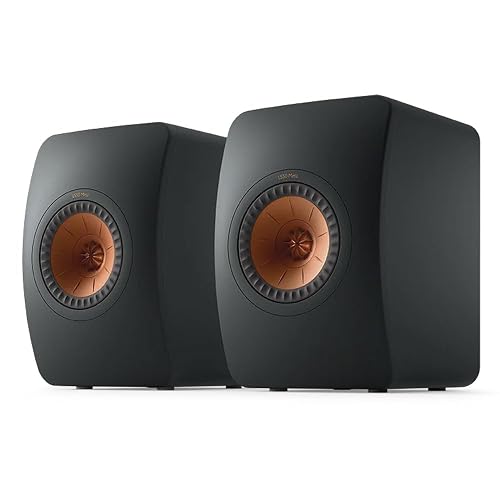
KEF LS50 Meta
- Published sensitivity
- 85 dB, 2.83 V at 1 m, full space
- Nominal impedance
- 8 ohms
- Minimum impedance
- 3.5 ohms
- Frequency response
- 79 Hz – 28 kHz ±3dB
- Type
- passive — needs an amplifier
What the published figures favour
- Frequency response published as 79 Hz – 28 kHz at ±3dB. Quoting the tolerance is the exception here, not the rule.
- Manufacturer states a recommended amplifier power of 40–100 W, which many of its competitors leave out.
- Cabinet dimensions published: 302 × 200 × 281 mm, so you can check it fits before ordering.
What to check before buying
- Below the median of this set once corrected: 85.0 dB against a median of 86.5 dB, so it needs more power for the same level.
- Impedance drops to 3.5 ohms. Check your amplifier publishes a 4-ohm rating before driving it hard — most AV receivers do not.
What reviewers report 6 published reviews read
The LS50 Meta is the most reviewed speaker on this page, and the reviews are unusually consistent with each other. The praise clusters almost entirely around one engineering decision — the Uni-Q coaxial driver, which puts the tweeter at the acoustic centre of the mid-bass cone — and the criticism clusters around the physical consequence of a 200 mm cabinet. Almost nobody disputes either. What reviewers disagree about is whether the bass limitation matters, and that turns out to depend on what you listen to and whether you will add a subwoofer.
Consistently praised
- Imaging is the most repeated praise across every source read. Reviewers attribute it directly to the Uni-Q driver: because the tweeter sits at the centre of the mid-bass cone, the two drivers behave more like a single point source. Several reviewers specifically note the stereo image holds together when you move off the central seat, which is unusual — most bookshelf speakers collapse into the nearer speaker once you shift a seat along.
- Tonal neutrality draws comparisons to studio monitors rather than domestic speakers. More than one reviewer describes the speaker as adding little of its own character, and frames that as the point rather than as coldness. If you want a speaker that flatters recordings, several reviewers say plainly this is not it.
- Detail retrieval and low-level resolution come up repeatedly, with reviewers noting quiet material and reverb tails staying audible rather than being buried. Build and finish are also called out as beyond the class norm, which matters on a speaker this visible.
Consistently criticised
- Low-frequency extension is the one consistent limitation, and every source raises it. Reviewers report useful output down to roughly the 40 Hz region and only when the speaker is not far from a wall. For acoustic and vocal material reviewers consider this a non-issue; for electronic music, film, or anything with sustained low bass, the recommendation to add a subwoofer is close to unanimous.
- Amplification is the second recurring caveat, and it is the one this page’s arithmetic predicts. At 85 dB the LS50 Meta has the lowest corrected sensitivity of the entire ranked set here, and one measured review puts the on-axis mean nearer 83 dB. Reviewers translate that into a practical warning: a modest AV receiver will run out of headroom before the speaker does, so budget for the amplifier as well.
- A minority of reviewers report a slight softening in the upper midrange that they describe as costing some attack on percussive material. This is not universal and is the least agreed-upon point in the set.
Reviewers point to it suiting
Listeners who value imaging and accuracy above scale, in a small-to-medium room, with a decent amplifier and ideally a subwoofer.
Reviewers suggest looking elsewhere if
You want deep bass from the speaker alone, you are driving it from an entry-level receiver, or you want a speaker that smooths over rough recordings.
Sources: The Absolute Sound · AVForums · Erin’s Audio Corner (measurements). These are other reviewers’ findings, not ours — we have not heard this speaker.
At a glance
| Model | List price | Published sensitivity | Comparable, 1 W / 1 m | Source |
|---|---|---|---|---|
| Q Acoustics 5020 | $1,199 | 87.9 dB 2.83V/1m-full | 86.6 dB | source |
| Bowers & Wilkins 606 S3 | $1,200 | 88 dB 2.83V/1m-full | 88.0 dB | source |
| KEF LS50 Meta | $1,600 | 85 dB 2.83V/1m-full | 85.0 dB | source |
What this page could not include
These bookshelf speakers are in our database, but their manufacturers do not publish a US list price, so there is no honest way to say which band they belong in:
- Klipsch RP-600M II — no list price on the manufacturer’s US page
- Edifier P12 — no list price on the manufacturer’s US page
- Edifier R1280T — no list price on the manufacturer’s US page
- Edifier S1000MKII — no list price on the manufacturer’s US page
- Edifier S2000MKIII — no list price on the manufacturer’s US page
We will not take a price from a retailer listing to fill that gap. Retailer prices move, and a band built on one would be wrong within the month.
Related
- Bookshelf speakers Under $500 — the same category, lower band
- Bookshelf speakers From $500 to $1,000 — the same category, middle band
- The whole bookshelf speakers category ranked by comparable sensitivity — every model on one basis
- The gear database — every figure used here, with its source
- How we work — the method, and where it breaks