7 home-theatre projectors from three manufacturers. Their brightness figures are published on 2 different measurement standards, so the numbers on the box cannot be compared to each other directly. We rank them anyway, with the standard attached to every figure, because that is the only honest way to put them in one table.
Last verified: 8 August 2026
The problem with the brightness number
BenQ and Hisense publish ANSI lumens. Epson publishes white brightness to ISO 21118 and colour brightness to IDMS, and publishes no ANSI figure at all for any of the three models here. These are different measurements taken under different conditions. Putting an Epson ISO figure next to a BenQ ANSI figure and declaring one brighter is the projector version of comparing a 2.83 V speaker sensitivity to a 1 W one.
We cannot convert between them, because unlike the sensitivity case there is no published constant to convert with. So we do not. The standard is in its own column, and a comparison across two different standards is a comparison you should not lean on.
Ranked by published brightness
| # | Photo | Projector | Brightness | Standard | Light source | Resolution as published | Throw | Source | Buy |
|---|---|---|---|---|---|---|---|---|---|
| 1 |  | Epson EpiqVision Ultra LS800 | 4,000 lm | ISO 21118 | laser | 4K PRO-UHD | ultra short throw | source | Check price |
| 2 |  | BenQ TK710 | 3,200 lm | ANSI | laser | 4K UHD (3840×2160) | standard | source | Check price |
| 3 |  | Hisense PX3-PRO | 3,000 lm | ANSI | RGB trichroma laser | 4K/60Hz | ultra short throw | source | Check price |
| 4 |  | Hisense C2 Ultra | 3,000 lm | ANSI | RGB trichroma laser | 4K/60Hz | standard | source | Check price |
| 5 | — | Epson Pro Cinema LS12000 | 2,700 lm | ISO 21118 | laser array | 4K PRO-UHD | standard | source | Check price |
| 6 | 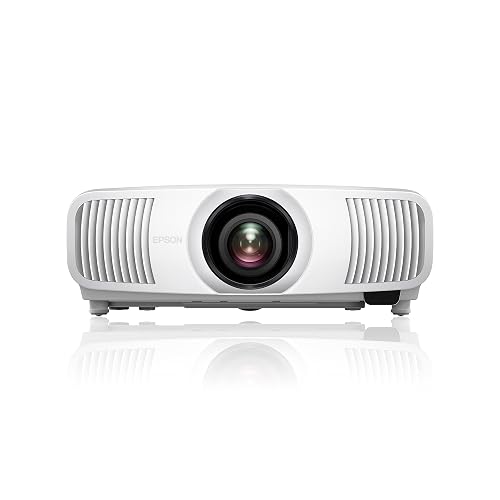 | Epson Home Cinema LS11000 | 2,500 lm | ISO 21118 | laser array | 4K PRO-UHD | standard | source | Check price |
| 7 |  | BenQ HT3560 | 2,200 lm | ANSI | lamp | 4K UHD (3840×2160) | standard | source | Check price |
Epson’s figure is white brightness. Epson publishes an identical colour-brightness figure to IDMS for each of its three models, which is worth noting because a projector whose colour brightness is far below its white brightness will look duller than the headline number suggests.
Contrast is worse
Brightness is at least measured. Contrast is published on bases that differ by orders of magnitude, and the basis is usually in small print or absent.
| Projector | Contrast as published | Basis |
|---|---|---|
| Epson Pro Cinema LS12000 | 2,500,000:1 | dynamic |
| Hisense C2 Ultra | 2,000,000:1 | dynamic |
| Epson Home Cinema LS11000 | 1,200,000:1 | dynamic |
| BenQ TK710 | 600,000:1 | with light source dimming |
| BenQ HT3560 | 50,000:1 | native |
| Hisense PX3-PRO | 3,000:1 | native |
The clearest illustration is within a single brand. The Hisense C2 Ultra publishes 2,000,000:1 and the Hisense PX3-PRO publishes 3,000:1. Both are rated at the same brightness, from the same manufacturer, and the figures are 667 times apart. The difference is not the picture. One is a dynamic figure, measured with the laser modulating between scenes, and the other is native. They are not the same measurement and should not be read as one.
Across the whole set the largest published dynamic figure is 2,500,000:1 and the smallest native one is 3,000:1 — a factor of 833. Ranking on that column would rank the small print, not the projectors, so we do not rank on it.
What “4K” means here
Every projector in this table is sold as 4K. Not one manufacturer publishes a native panel resolution on the pages we read.
Epson states plainly that its 4K is produced by shifting each pixel rather than by a native 4K panel, which is more disclosure than most. BenQ publishes the output resolution, 3840 × 2160, and does not publish the native DMD resolution on its specification page. Hisense publishes “4K/60Hz” and no panel figure. We record what each one publishes and leave the rest blank, because the alternative is to infer a panel size from the chip class and present our inference as the manufacturer’s number.
What is not published
| Projector | Missing |
|---|---|
| Epson EpiqVision Ultra LS800 | price, contrast ratio |
| BenQ TK710 | price |
| BenQ HT3560 | price |
BenQ publishes no price on either specification page we read. We leave the field empty rather than taking a figure from a retailer, because a retailer price is not the manufacturer’s position and changes weekly.
Related
- Two speakers, both “87 dB”, three decibels apart — the same problem in loudspeaker specifications
- System Headroom Calculator — the audio side of a home cinema
- Atmos Layout & Amp Assignment Planner — speaker placement for the room you are projecting in
- How we work — the method, and where it breaks